Archive for November, 2010
The 2011 Vacation
I know, it’s not even December, but hey, what’s wrong with having an early vacation planning now, right? Ever since we have a child, traveling is no longer fun..oh, even pre-baby years, I was never fond of traveling. It is tiring and sometimes being caught in the traffic or get stuck at the airport make it all worse.
Do you know what kind of vacation you love? Is it adventure, urban, scenic or beach vacation? I know that I am not an adventurous type. The idea of going for a hike, cross country ski, white water rafting, camping with no electricity are certainly not in the list when anyone mentions vacation to me.
I usually will seek out travel advice online because I need to prepare myself mentally whenever we want to go on vacation. I need to know what’s the hotel will be like, where will I get my lunch, dinner, supper, will there be any place for me to do some shopping, you know things like that.
Now that I have a child, I need a stronger mental preparation. I need to look out for ways to entertain my son while enduring the long hour of the trip. I have to know whether the kid-friendly environment as mentioned in the hotel website is up to my standard of expectation. And most important fact of all, will we enjoy the vacation as family.
I hope doing the vacation planning homework earlier will not disappoint me, hopefully it will be helpful. After all I really need next year vacation trip to refresh my mind and soul.
Why Boys Like Car Toys?

Nature is mysterious, you never know for sure why certain things happen the way they are. Same goes to the fact of why boys like car toys and girls love dolls.
Quoting from an article I read online,
A traditional sociological explanation is that boys and girls are socialized and encouraged to play with different types of toys by their parents, peers, and the “society.†Growing scientific evidence suggests, however, that boys’ and girls’ toy preferences may have a biological origin.
We have exposed our son to a lot of other toys – bike, train, kitchen set, hand puppet, books, art and craft, stuff toys. The only thing we will not buy for him is a Barbie. He plays with all those toys mentioned above but nothing caught his eye like a car toy…the sparkle in his eyes that is worth more than RM6.90 per hot wheels. As I am writing this now, he is asleep with 2 of those cars. I think boys are just wired that way..heh!
Games to Teach Reading Designed with Cognitive Development
Reading is an important skill for a child to learn and there are different teaching methods that can be used to help a kid develop this knowledge. One of the ways is to introduce a young mind to games to teach reading, especially games that have been designed to improve a child’s cognitive development.
What is cognitive development? It is a process through which a person improves their ability to think, learn, reason, remember, understand, and take meaning from the world that surrounds them. Reading is a cognitive activity and it involves more than simply knowing letter sounds. Kids need to learn how to combine their letter knowledge with other clues that exist inside and outside of text in order to gain true value from language and become effective readers. Thus, games to teach reading that focus on the cognitive processes that lies behind reading, and provide kids with various opportunities for practicing will help them develop better thinking habits, making them better readers.
Learning how to read effectively isn’t only simply a matter of learning the alphabet, recognizing letters and sounding out words, it’s also a matter of gaining true comprehension of what is being learned through critical thinking and problem solving strategies. Hence, games to teach reading that provide these types of challenges command the attention of a child and help them develop the many skills that are essential for reading. Such interactive games can be found online.
The Five Love Languages of Children
I’m quoting this from a reviewer in Amazon. I hope I will be able to buy this book from ebay soon. (Updated: Checked MPH website, and it is also available at the book store for RM39.90)
Chapman, with co-writer Ross Campbell, M.D., have written The Five Love Languages Of Children, which applies the love language theory to children. How can you tell your child’s main love language? Chapman offers these suggestions:
1. Observe how your child expresses love to you.
Chapman and Campbell: Watch your child; he may well be speaking his own language. This is particularly true of a young child, who is very likely to express love to you in the language he desires most to receive.
I’ve seen this with my own 4 1/2 year old. Noah will come up to me or my husband, and try to engage us in a wrestling match. Or he’ll pat our arms, give us a hug, etc. He has shown us that his main love language is that of Physical Touch!
2. Observe how your child expresses love to others.
If you notice your child making crafts for relatives, or wanting to take presents to classmates or teacher, this may indicate that her primary love language is Gifts.
3. Listen to what your child requests most often.
If your child often asks you questions like “How do I look, Mommy?”, “What do you think of my drawing?”, or “Did you think I did well at practice today?”, this pattern may indicate that his love language is Words of Affirmation.
4. Notice what your child most frequently complains about.
Frequent complaints such as “You never have time for me”, “Why don’t you play games with me?”, or “We never do things together” would be indicative of the need for Quality Time.
5. Give your child a choice between two options.
Chapman and Campbell suggests to lead your child to make choices between two love language. For example, a Dad might say to his son, “I have some free time Saturday. Would you like me to fix your bike, or would you rather go to the park together and shoot some hoops?”. The choice is between Acts of Service and Quality Time. A mother may say, “I have some time tonight. Would you like to go shopping, and I’ll help you pick out a new outfit, or would you rather stay home and we’ll do a puzzle together?” You’ve given her the choice between Gifts and Quality Time.
Chapman and Campbell explain: As you give options for several weeks, keep a record of your child’s choices. If most of them tend to cluster around one of the five love languages, you have likely discovered which one makes your child feel most loved. At times, your child will not want either option, and will suggest something else. You should keep a record of those requests also, since they may give you clues.
Of course, the choices you offer your child will depend on age and interest.
Sarah’s Key
I bought this book during the previous Big Bad Wolf sale which we went on Saturday. I started reading it that night and really got stuck with it. It took me 2 nights to finish the book. If I was childless, I could finish it in a day..heh!
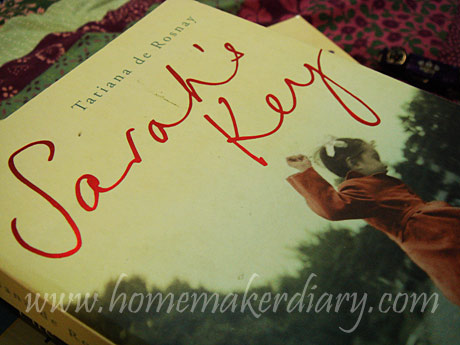
I never know about the author before but I have came across the title on MPH website, thus why I chose this book to buy among others.
Here are some interesting info about the book.
*How long did it take you to write Sarah’s Key?
It took me one year to research it, two years to write it, and two years to get it published!
*Sarah’s Key by Tatiana de Rosnay is published in 38 countries and has sold over two million copies worldwide. A movie starring Kristin Scott-Thomas has been released in Europe (in French).
For those who wonder what’s the book is all about, here is the synopsis:
Paris, July 1942: Sarah, a ten year-old girl, is brutally arrested with her family by the French police in the Vel’ d’Hiv’ roundup, but not before she locks her younger brother in a cupboard in the family’s apartment, thinking that she will be back within a few hours.
Paris, May 2002: On Vel’ d’Hiv’s 60th anniversary, journalist Julia Jarmond is asked to write an article about this black day in France’s past. Through her contemporary investigation, she stumbles onto a trail of long-hidden family secrets that connect her to Sarah. Julia finds herself compelled to retrace the girl’s ordeal, from that terrible term in the Vel d’Hiv’, to the camps, and beyond. As she probes into Sarah’s past, she begins to question her own place in France, and to reevaluate her marriage and her life.
